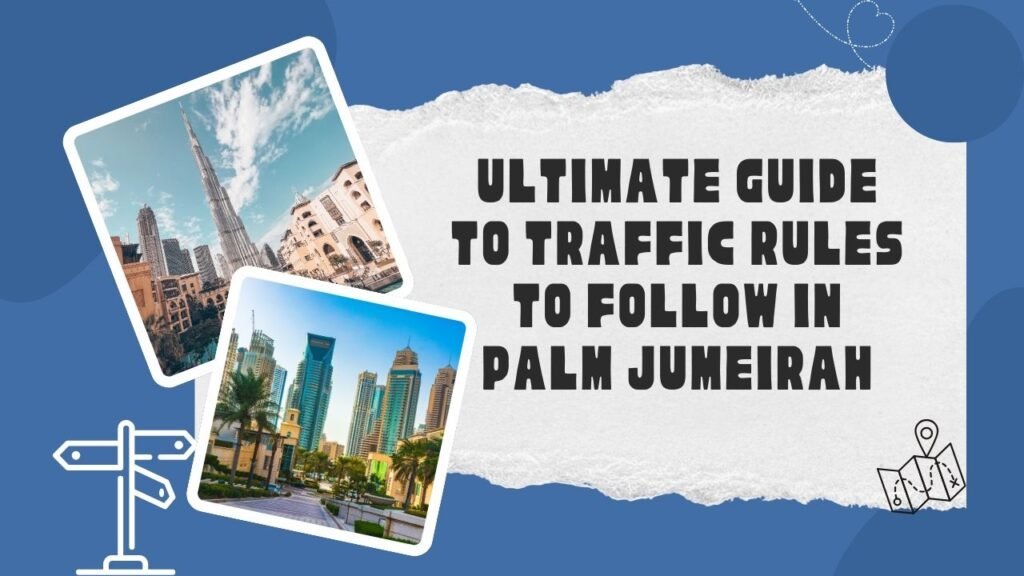
Palm Jumeirah Dubai, is commonly known as the “Eighth Wonder of the World”. This place is an artificial island that resembles a palm tree. Though it is an entirely integrated part of the city, it can also seem like an island resort in the far-flung corners of the earth. Clearly, it is under tight surveillance by the Dubai Police and adheres to the tough guidelines laid down by the Roads and Transport Authority (RTA).
This guide has been written to help you through every nook and cranny of the roadways so that you can appreciate the beautiful sight of Palm Jumeirah without worries.
Follow these Traffic Laws When Driving in Palm Jumeirah, Dubai
Dubai government has laid down the traffic rules to make sure that no one, from pedestrians to supercar owners, is put in harm’s way.
1. Legal Documents Required While Driving
However, before you drive, you must also see to it that your papers are in order. Otherwise, in the United Arab Emirates, your vehicle can be confiscated because you cannot muster the required legal documents that a police officer demands from you.
Dubai is moving towards a “smart” system. You can now display the soft copy of your registration and license through the RTA Dubai or Dubai Police smartphone app. But having a printout is always an excellent backup option.
2. Speed Limits You Must Follow
The most common traffic violation in the UAE is speeding. Advanced radars used by police are able to catch speeders across many lanes at one time.
- Residential Fronds Speed Limits
The “fronds” are the residential leaves of the Palm. These are quiet neighborhoods where families walk, and children play. The speed is limited to 40 km/h normally, because such roads are narrow and usually have cars parked alongside the roads. High speeds here are simply dangerous and strictly penalized, so you would not be caught in a car accident situation and need emergency car recovery services.
- The Trunk and Main Arteries
The primary six-lane road that links the mainland to the remainder of the Palm is known as the “Trunk”. The speed limit should usually be between 60 and 80 km/h.
The Buffer Rule: There is a “20 km/h grace buffer” in Dubai. The camera will typically flash at 81 km/h if a sign indicates 60 km/h.
Note: If you are travelling between cities, use caution because this buffer does not apply in the nearby emirate of Abu Dhabi.
- The Crescent and Tunnel
There is a tunnel between the trunk and the Atlantis and the crescent that has its own radars. Here, the speed limit should be 60 km/h. The tunnel is bent and might be slippery in case there is condensation or any repairs taking place. Always stay within the limit.
3. Seat Belt and Child Safety Rules
The Emirates road safety regulations are established with the “Safety First” motto in mind. Seat belts must be used; they are an obligatory condition for every single soul inside the vehicle. In the past, only those who were seated in the front seats were required to use seatbelts. But now, all individuals, even those who were seated in the back seat, are required to use seatbelts. Children are the most vulnerable ones while traveling on the roads. All children must sit in the appropriate seats, restrained for children. Children below 10 years or 145cm tall cannot be allowed to sit in the front seat.
4. Mobile Phone Use While Driving
Everybody wants to drive across the Palm and get the ideal Instagram photo of the Atlantis or the Burj Al Arab. But doing so while holding your phone can be a costly error.
- Handheld vs. Hands-Free
Holding a cell phone or any other gadget while the car is moving is forbidden by Dubai traffic laws. Being stopped at a red light is one example of this. Your phone can only be used for calls or navigation if it is mounted on a dashboard holder or linked to a hands-free system (Bluetooth). Four black points and an AED 800 fine are associated with distracted driving.
5. Driving Under the Influence of alcohol Laws
It is probably the most vital part of this entire guide. The UAE maintains a zero-tolerance approach in terms of alcohol and operating motor vehicles.
In most European nations, there is a “blood alcohol limit” (for example, 0.05% or 0.08%). In the UAE, the limit is 0.00%. Arresting, a fine imposed by the court (which begins at AED 20,000), impounding of the vehicle, and deportation are the consequences if one gets arrested while driving under the slightest consumption of any kind of intoxicating beverage.
6. Lane Discipline and Overtaking Rules
Generally speaking, unless you are passing, you should stay in the right lanes. Overtaking and emergency vehicles are allowed to use the leftmost lane, also known as the “fast lane”.
- Overtaking: You should always pass from the left. It is deemed “dangerous driving” to overtake from the right and may result in a fine.
- Indicators: Each time you change a lane, you must use your turn signals. In the Palm’s roundabouts, failing to signal is a frequent source of accidents.
7. Traffic Signals and Road Signs Compliance
In the Palm, there are many signs on roads that may be unknown to foreigners. Starting from pedestrian signs to dedicated lanes on roads designed for monorails, care should be taken while observing them. Running the red light could be dangerous. It may cause a fine of AED 1,000. You will have your car impounded for a period of 30 days. Addition of 12 black points to your record.
8. Two Second Rule of Safe Distance and Tailgating
On Dubai’s roads, tailgating (driving too close to the car in front) is a major problem. It is extremely deadly and aggressive.
According to RTA traffic regulations, you should keep a minimum distance of two seconds (more in the event of rain or fog) between you and the car in front of you. Tailgating carries a 400 AED fine and four black points. Additionally, Dubai has recently installed radars made specially to measure the separation between automobiles. Being too close to the car ahead of you can result in a citation even if you are not speeding.
9. Parking Rules in Palm Jumeirah
The guidelines for parking in Palm Jumeirah are very strict:
Where to Park
- Malls: The Nakheel Mall has extensive car parks with air-conditioned parking.
- Hotels: Hotels usually provide valet parking facilities.
- Common Beaches: Some areas, like West Beach, have underground parking lots.
Where NOT to Park
- On the Fronds: Unless it is for the resident or guest with a permit, do not park on the fronds.
- Pavement: Parking on the sidewalk or curb is a serious infraction.
- Emergency Access: Do not park or block fire hydrants and yellow-marked areas.
10. Police Checks and Traffic Accidents
Handling a Minor Accident
If there are no injuries or minor damage from the accident:
- Transfer the vehicles to the shoulder of the road, which is a secure location.
- Launch the app for Dubai Police.
- Make use of the “Minor Accident Report” function. You snap pictures of both vehicles and input the information.
- Both parties will receive a report from the police via SMS, which you subsequently forward to your insurance provider.
Handling a Major Accident
If the vehicles cannot be moved or there are injuries:
- Make an instant 999 call.
- Await the arrival of the ambulance and police.
Summary of Traffic Rules
The following table shows the summary of all the traffic rules that must be followed in Palm Jumeirah, Dubai:
| Traffic Rule Category | Official Requirement in Dubai | What Drivers Should Know |
| Driving Side | Drive on the right side | Left-side driving is not allowed in Dubai |
| Speed Limits | Vary by road type | Residential roads are slower, while main roads allow higher limits with cameras active. |
| Seat Belt Law | Mandatory for all occupants | Front and rear passengers must wear seat belts |
| Child Safety | Child seats are compulsory | Children must be seated in approved child restraint systems |
| Mobile Phone Use | Handheld use is prohibited | Only hands-free systems are legally allowed |
| Alcohol and Drugs | Zero tolerance policy | Any level of intoxication is a serious offence |
| Lane Discipline | Keep right unless overtaking | Overtaking is permitted only from the left |
| Traffic Signals | Must be followed at all times | Jumping a red light can lead to heavy penalties |
| Salik Toll System | Automatic electronic toll | Ensure your vehicle has an active Salik tag |
| Parking Rules | Only in designated areas | Illegal parking can result in fines or towing |
| Required Documents | License registration insurance | Documents must be valid and available for inspection |
| Accident Procedure | Police report required | Do not move vehicles unless instructed |
| Police Checks | Random checks allowed | Cooperation with authorities is mandatory |
Frequently Asked Questions
Are tourists allowed to drive in Palm Jumeirah, Dubai?
Yes. Foreigners can drive their cars in the Palm and the rest of Dubai. If you come from countries like the US, UK, or the GCC states, you can drive a rental car using your license from back home. But others would need an International Driving Permit.
Are Salik fees charged on Palm Jumeirah Roads?
There are no toll gates on the island. You will, however, go through the Salik gate when you use the highway route if you are coming either from the airport or Downtown.