
A common sign your car’s AC needs fixing or repair is if it blows warm or weak air, but you can fix your car’s ac at home easily. You can easily diagnose the problem responsible for that warm or weak air of AC by following a logical path, even without a degree in engineering. Let’s jump into a simple step-by-step guide to repair your car’s ac yourself.
Steps to Diagnose a Car’s AC Problem Yourself
Expensive equipment is not necessary to diagnose your car’s AC problem. Use your senses first.
Test Air Temperature and Strength
Feel each vent with your hands. You may have a blend door problem if the driver’s side is warm while the passenger side is cold. The blend door is a little motor that directs air within the dash. Check the cabin filter first if all of the vents are weak.
Listen for Mechanical Clues
When you press the AC button, pay attention to the engine. As the computer adjusts for the additional load, you should hear a little shift in car engine RPMs (Revolutions Per Minute). The computer isn’t even attempting to switch on the air conditioner if nothing changes.
Check Fuses and Electrical Connections
Check your owner’s manual for the location of your car’s fuse box. It may say AC, Comp, or Heater. A blown fuse is an extremely inexpensive fix that most people can overlook before enlisting a mechanic. Also, verify the wires plugged into the top of the compressor haven’t come loose over time.
Step-by-Step Guide to Fix A Car’s AC Yourself
Inspect the System Visually
Diagnosing the problem remains the first step in solving every type of problem. Turn on the flashlight and search for the faulty area. You are searching for wet areas on metal lines or hoses. A leak will frequently appear as a greasy, dusty mark because AC refrigerant contains a unique oil.
Replace or Clean the Cabin Air Filter
It’s actually the most neglected aspect of car maintenance. The cabin air filter intercepts dust, pollen, and debris before they reach your air vents inside your car.
If it’s full of dust, it means that there’ll be little air passing through, and it’ll work twice as hard for cooling purposes. Most cabin air filters can be accessed by removing the glove compartment in five minutes without needing any tools.
Check and Recharge Refrigerant
You can recharge the refrigerant for colder air by yourself. But, a note of caution here: when you are low on refrigerant, it’s a signal that you are leaking refrigerant somewhere in your system.
According to expert mechanics, refrigerant doesn’t wear out; it slightly evaporates due to leakage somewhere in the system. While a recharge may be a convenient and quick solution, you will need to locate the leak.
Clean the Condenser and Evaporator Coils
The condenser AC is a small radiator and is placed just in front of your car. After some time, it can collect some insects, dirt, or plastic bags. It cannot dissipate heat from the refrigerant if it is dirty. To clean the dirt, lightly sprinkle it with a garden hose.
Evaluate the Compressor and Clutch
With the engine on, ask a friend to flick the AC switch on and then off. Check the AC compressor. The middle of the pulley, or the clutch, should click and begin to rotate. If the pulley is moving but the middle isn’t, your compressor is not working.
Test System After Repairs
After you have made your adjustments, turn your air conditioner on and let it set at the coldest temperatures and the fastest speed. You need to let the conditioner run for a minimum of five minutes.
Using a kitchen thermometer at the center vent, you can check that the air from a good air conditioner is considerably cooler than the cabin of your car, by approximately 40-50° F.
The 3-minute Rule for Air Conditioners
The 3-Minute Rule is an easy safety tip designed to protect your AC’s most expensive component, the compressor.
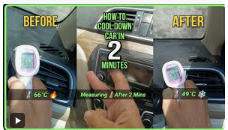
When you turn off your air conditioning system, your refrigerant remains under extremely high pressure. Restarting immediately will result in your system malfunctioning—either your system may start to heat up, your fuse may blow, or your motor may be seriously damaged due to compressing extremely high pressures. So, wait for at least 3 minutes.
Pressure Equalization: This helps in equalizing the pressures by allowing the gas to settle for at least three minutes.
Compressor Health: By turning on the system when the pressure is equalized, a “soft start” is achieved, which exerts far less stress on the engine mechanically.
Tips for Preventive Maintenance
The most effective way to save money on air conditioning repair is to take special care of it before it breaks.
- Run it in the Winter: This may sound foolish, but you have to start the AC for 10 minutes every week, no matter the season. This helps keep the oil flowing through the seals.
- Service it Yearly: You need to have the pressures checked every year at a mechanic shop so that a small leak in the unit can help extend the life of the compressor, which can cost up to a thousand dollars.
When Should You See a Professional?
Do-it-yourself is great, but the AC system is one of those rare parts of the car where you can actually cause more damage if you are not careful.
- Major Leaks or Refrigerant Handling
Refrigerant is a chemical that can be harmful to the environment and your skin. When there is a massive leak, you cannot simply keep adding more. A professional has a recovery machine with which he can safely suck out the gas, repair the leak, and put it back in without wasting money or polluting.
- Compressor or Condenser Replacement
These are sealed system repairs. The system must be opened to replace a compressor. Your new parts will be destroyed if moisture from the air seeps inside and turns the internal oil into acid. Before replenishing, experts use a hoover pump to eliminate all moisture and air.
- How to Choose a Good AC Mechanic?
When looking for a car AC specialist near you, try to find stores that provide performance or leak inspection. A competent mechanic would investigate why your petrol got low in the first place rather than simply ‘top off’ it.
- How Much Does Car AC Repair Cost?
For most drivers, cost is their main issue. The costs are different depending on the city and type of vehicle, but you can have an average estimate.
| Repair Type | Estimated Cost |
| Cabin Air Filter | $20 – $60 |
| Refrigerant Recharge | $150 – $300 |
| AC Hose Replacement | $200 – $450 |
| Blower Motor Repair | $250 – $600 |
| AC Compressor Replacement | $800 – $1,500 |
Frequently Asked Questions
Can I repair my own automotive air conditioner?
You can take care of filters, cleaning the condenser, and even basic electrical matters. But for anything related to the internal pipes and gases, you would be wise to seek the services of a professional.
Does fixing a car’s AC compressor cost a lot of money?
Indeed, it is sometimes a costly repair. This is because internal compressor failures frequently transport microscopic metal fragments throughout the entire system, necessitating the flushing or replacement of other components.
Can a filthy cabin filter damage the car’s AC? Indeed! A blocked filter functions similarly to a wall. It prevents airflow, which makes the evaporator extremely cold and solidifies into a block of ice, halting all airflow.