Why Towing an EV Is Not the Same as Towing a Petrol Car
In modern-day circumstances, the concern about electric cars like Tesla has shifted from being concerned about the mechanics to being concerned about more sophisticated issues. When you look at the electric like a damaged Tesla or a damaged Hyundai Ioniq, you may not feel comfortable when you are standing beside the car after a crash. You may wonder if the battery is all right, or it has suffered some internal damage? What if it goes up in flames several hours later when parked somewhere?” You can definitely use AI for a safer recovery of EVs. So don’t worry, you are at the right place.
The main difference between a gas car and an electric vehicle (EV) is the fuel used. A petrol tank is basically just a container; once it’s empty, the fire risk is pretty much controlled. An EV, on the other hand, has a lithium-ion battery pack that acts as a live chemical reactor.
In the case of an accident involving an electric vehicle, damage may be done to its batteries, and such damage may not be readily apparent after a crash. In addition, conventional towing procedures, such as using a two-wheel tow with the driving wheels still on the ground, may produce electricity through regenerative braking systems in such cars. As a result, a fire may be created from what could be a minor car breakdown.
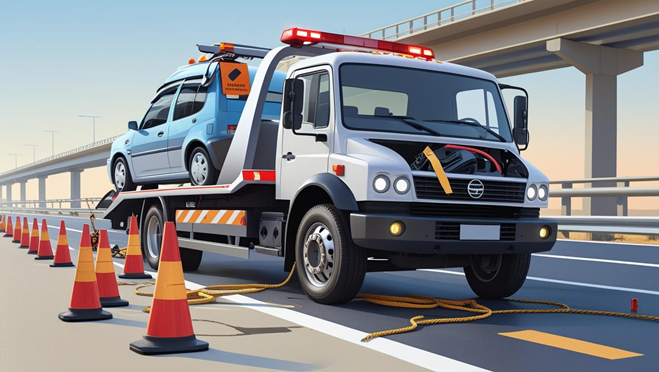
Making the right choices can really enhance safety, and in the EV world, that usually starts with using a flatbed truck and having a solid grasp of battery chemistry.
Understanding Battery Health During EV Recovery
What happens inside an EV battery after impact? A battery is made up of thousands of tiny cells. An impact may crush these cells or damage the separators between them. When a separator fails, it creates an internal short circuit.
Unlike mechanical failure, this chemical failure generates its own heat. The dangerous part is that this heat may increase gradually. A vehicle may look perfectly fine along the highway, but internally, a hot spot is developing.
The Real Risk of Thermal Runaway
Thermal Runaway is the name of a chain reaction that occurs when the internal heat surpasses a particular threshold. For recovery operators, this is their worst nightmare. When one cell overheats, the cell next to it overheats, and so on, until a high-intensity chemical fire engulfs the entire pack.
These fires are infamously hard to put out. They can rekindle days after the first incident and don’t require outside oxygen to burn. When using such high-stakes technology, it’s fair to have concerns for your future, but what sets an expert apart from an amateur is realizing that the danger is frequently postponed.
Introducing the EV Specialist: Recurrent AI
Technology fills the gap where human observation is otherwise required. Recurrent AI is the new generation for safety. Rather than having to hazard a guess about the status of the battery, the recovery teams can now rely on the expertise of the AI model, which has assessed millions of miles of data for electric vehicles.
Recurrent AI is developed to analyze the State of Health and State of Power of a battery, too. In a recovery context, this will be able to analyze live signals, for example, the voltage changes and temperature surge, to help with the risk profile of the car even before it is connected to the tow truck. The right plan is all that is needed for things to come together, and AI is the plan for a modern fleet and recovery company.
What AI Brings to Recovery Operators
AI has enormous strategic importance for a towing company. It can monitor safety of EV battery in real life. Also, by establishing authority in a certain sector, it captures the expanding EV market.
- Enhanced Confidence, knowing they aren’t carrying a ticking time bomb into their yard gives operators a sense of security.
- Fewer Unknowns, in high-risk recovery scenarios, data eliminates uncertainty.
- Better Documentation, AI offers a digital record of the battery’s condition, which is crucial for liability protection and insurance claims.
- Clear Communication, if the battery was steady during transportation, you can give authorities and insurance a professional report.
Preparing the Towing Industry for an Electric Future
The towing industry is at a pivotal moment. As electric vehicles continue to rise, it’s those kinds of companies that are going to be able to succeed-caring for battery technology in very much the same way a chemist would. As everyone understands, this might make a number of people concerned for their future, and I think that is pretty natural; after all, your career has only just started.
Embrace the future of AI tools like Recurrent AI now, and you set up your business for success in the years to come. It’s not just about making safety a buzzword on the side of your truck but building it as a promise with data behind it. Done proactively, this can shape future towing regulations and help build trust between technology partners and recovery teams.
Final Thoughts
Stronger winches and larger vehicles are not the only things that will shape towing in the future. It has to do with intelligence. AI techniques like Recurrent AI provide a layer of visibility where the most serious dangers are concealed, and electric vehicles require a different strategy. You still have time to adjust. By using these tools, you can ensure that your firm remains safe in an electrified world while still achieving your goals.
Frequently Asked Questions (FAQs)
Question 1: Why is EV towing considered a high-risk activity?
Answer: Because the possible damage to the batteries may not readily be apparent with the naked eye. This could result in heat and instability building up days or weeks after the recovery and present a storage yard fire risk.
Question 2: Is thermal runaway prediction possible with AI?
Answer: AI finds risk patterns and warning signs through voltage and temperature data. AI may not ensure an outcome, however, it greatly contributes to prevention through early warnings about thermal instability.
Question 3: Does Recurrent AI have value only after an accident?
Answer: It is used for recovery following breakdowns, crashes, and transportation. Continuous tracking enhances safety in all aspects, given observation of battery performance patterns.
Question 4: Does AI slow down the towing process?
Answer: Often, it enhances speed by removing the element of guesswork. Clear data translates to better, faster, and more secure decisions to hook up or move.